

Have you ever gotten up from a restless night, hopped out of bed, and made breakfast only to notice that you’re sweating as you stir your oatmeal on the hot stove? Have you ever been exceptionally hot in your house? Like sweating? Thinking to yourself, “Did I pay the electric bill?” Yes! “Are all my doors and windows closed?” Yes! “So why am I burning up?!”
If you find yourself asking this question this season, that could be the result of HVAC issues. And if you don’t get to the bottom of it, you’re in for a long summer. Keep reading to find out the most common HVAC issues and how they can be resolved.
Your System May Be Low On Refrigerant
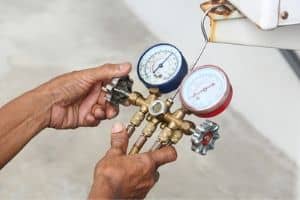 The refrigerant is one very important component of your air conditioner. In fact, it’s the chemical that keeps us cool. Without it, your Air Conditioning is rendered useless against the Midwestern summers.
Check to make sure there is no liquid leaking out of your AC unit. A dark-colored splotch on your wall or below the unit is a tell-tale sign of a leak. There could also be a lack of refrigerant in your unit, causing it to produce lukewarm air rather than a steady flow of cool air.
Refrigerant leaks can be quite common and can be fixed with the help of a professional. If you believe you may have a leak, contact a professional immediately so they can fix the problem before it becomes a bigger one.
When Was the Last Time You Cleaned Your Unit?
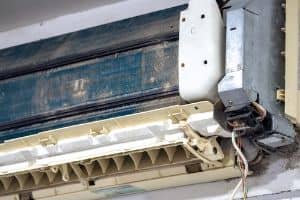 Sometimes we assume the worst. We create problems that seem bigger than they really are. In other words, your AC problems may simply be the result of a dirty unit.
Your outdoor unit has coils that filter the heat from the air by sending it outside. This indoor/outdoor airflow can cause a layer of grime to form on the condenser coils.
Once that layer of dirt covers the coils, they stop working, causing the entire system to work harder. This can lead to a system failure, which is a much bigger problem. In order to avoid bigger issues down the road, make sure to check your condenser coils and clean them when necessary to avoid build-up.
Wrong Installation From the Start
 If you didn’t relate to these first two problems because you just got a new HVAC unit, you might consider the possibility of incorrect installation.
HVAC installation is not an easy process, and it must be done by quality professional contractors. If your HVAC is truly brand new and has stopped working, there is a high probability that you will need it to be reinstalled.
If you are having problems with irregular temperature, loud or unusual sounds from your unit, or odd odors coming from the unit, this could mean your HVAC was improperly installed. Don’t let these problems continue, for they can only get worse with time.
If you have questions or are having trouble with your HVAC unit, call us! It’s important to fix the problem early on so that it doesn’t lead to bigger issues when you need it most - like in the summer. Keeping your HVAC happy will keep you and your family even happier all summer long.

 Few things are more insensitive than an HVAC system. The system turns on and off according to the program you set.
 One of the easiest, least expensive, but often overlooked action to protect your unit is to replace your system's filters every year.
 Natural gas itself is odorless, but a sulfur-like odor is added to it by utility companies so that you can detect a gas leak if it should ever occur. A gas leak should never be taken lightly. If it is not resolved quickly, it can cause a fire or explosion in your home and injury to you and others. Inhaling gas can also cause serious illness, even death. If you suspect you may have a gas leak in your home, leave the premises immediately and call 911.
 Winter has arrived, and you turn on your furnace for the first time since last year, only to notice a smell reminiscent of a musty basement. This is particularly common in older homes. A musty odor can be caused by dirt and debris that has accumulated in your gas appliance and the air ducts.
 If you notice a sharp smell of ozone or burning diesel inside your home, check your heating system. Sometimes the bearings in your appliance will force the motor in the blower to bind, which forces the furnace to pull more electricity to push through.
 Choosing to upgrade your air conditioner, furnace, or both isn't an easy decision, and there are many factors at play to consider. The issue that holds the most weight is the age and condition of your current appliances, because if your A/C and furnace are dying, then you’ll have to replace them both.
 As with most major decisions, money will be a major element that could swing the pendulum in one direction or the other. For example, if you only have $2,000 to spend, then you probably can’t replace both units now and pay for the installation, so it'll make sense to replace the appliance that’s in most need of an upgrade and wait on the other one.